Friday, January 30, 2026
1945 MOSTAR - First Day of Issue

Wednesday, January 28, 2026
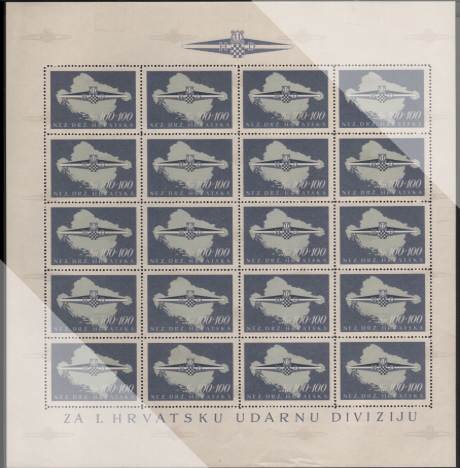
1945 NDH - Storm Division Sheets


Saturday, January 17, 2026
1945 MOSTAR – Mystery Postal Card
A notable postal card sent from Široki Brijeg to Belgrade in June 1945 raises some questions. The card was broken in half at some point, but the exact circumstances of its severance and the identity of the repairer remain a mystery. While the exact moment of damage cannot be determined with absolute certainty, the presence of official "VOJNA CENZURA BEOGRAD" (Military Censorship Belgrade) tapes suggests that it is most likely that the card was severed during the censorship process. Whether it was damaged during the hurried opening of mail bags or rough handling during inspection, the fact that it was resealed with official adhesive tape points to an official intervention before it reached the addressee.

Monday, January 12, 2026
1945 SPLIT - Postal Card Overprint Varieties


Thursday, January 8, 2026
1945 SPLIT - Curved Perforation
One accidental flaw in line perforation is irregular or wavy perforation. This type of anomaly is a specific risk of line perforation machinery; unlike comb perforation, where the grid is fixed, line perforation processes each line independently. This flaw occurs when the sheet of paper is not perfectly aligned or shifts slightly during feeding. If the paper moves while passing under the perforating needles, the needles strike in a curved or wavy path rather than a straight line, resulting in a structural dislocation.

Tuesday, January 6, 2026
1941 LJUBLJANA - Mail to Novi Sad
During the war, mail followed complex routes, as all items were redirected to central censorship offices before being forwarded to their destination. Correspondence from Ljubljana was sent deep into Italy to centres like Bologna for examination before being returned to the postal system for final delivery. As shown on the cover below, in occupied Vojvodina, the postal service was evidently managed by the Hungarian military post at that time.


Saturday, January 3, 2026
1944 DB Laibach, Chemical Censorship
During World War II, German military censorship was applied to all mail in occupied territories. Censors scrutinised entire messages and redacted prohibited content. To bypass these measures, individuals sometimes used invisible ink—also known as sympathetic or covert ink. However, this was a risky endeavour, as the Auslandsbriefprüfstellen (ABP) subjected approximately 3% of all mail to chemical testing to detect hidden messages.