Friday, January 30, 2026

1945 MOSTAR - First Day of Issue

Covers franked with the Mostar Provisional Issue are exceedingly rare. While three distinct tariff periods exist, items from the first and second periods are significantly scarcer than those from the third. Of particular interest is the first period, where the rates aligned with the so-called 'Split Tariff': a 20 Kn basic letter rate and a 30 Kn registration fee. The cover shown below is the only known example used on the First Day of Issue...

1945 Mostar Provisional Issue: Registered commercial cover franked with 50 Kn using Mi. 7 (20 Kn basic letter rate + 30 Kn registration fee), sent from Mostar to Dubrovnik on April 28, 1945. Features a Trebinje transit postmark of May 3 and a Dubrovnik arrival postmark of May 6. Censored in Mostar with a single-line cachet "CENSURA". First Day of Issue!

Wednesday, January 28, 2026

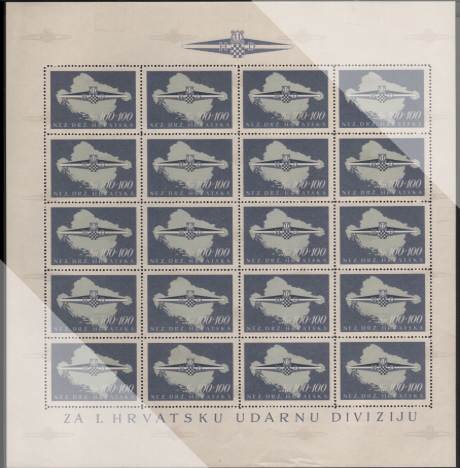
1945 NDH - Storm Division Sheets

The 1st Croatian Storm Division (Udarna divizija) was an elite unit formed on October 9, 1944. To commemorate the unit, a special philatelic issue was released on January 9, 1945. Today, complete sheets of this issue are considered among the gems of NDH philately.

Mi. 170, 50 + 50, Soldiers of the Storm Division.

Mi. 171, 70 + 70, A battlefield at night.

Mi. 172, 100 + 100, The Storm Division insignia on top of the Croatia map.

Saturday, January 17, 2026

1945 MOSTAR – Mystery Postal Card

A notable postal card sent from Široki Brijeg to Belgrade in June 1945 raises some questions. The card was broken in half at some point, but the exact circumstances of its severance and the identity of the repairer remain a mystery. While the exact moment of damage cannot be determined with absolute certainty, the presence of official "VOJNA CENZURA BEOGRAD" (Military Censorship Belgrade) tapes suggests that it is most likely that the card was severed during the censorship process. Whether it was damaged during the hurried opening of mail bags or rough handling during inspection, the fact that it was resealed with official adhesive tape points to an official intervention before it reached the addressee.

1945 Mostar Provisional Issue, Postal Card, sent from Široki Brijeg to Belgrade on June 14, 1945. Censored by Military Censor in Belgrade with a framed three-line cachet "ЦЕНЗУРИСАНО БЕОГРАД Војни цензор, бр. 10". Post offices tolerated late use of the Split Tariff for postal cards until their withdrawal from circulation. The postal card was broken in half and subsequently resealed with official censor tapes.

Monday, January 12, 2026

1945 SPLIT - Postal Card Overprint Varieties

The 1945 Split Provisional Type 1 postal card features a two-colour overprint in red and black. Because this process required two separate passes through the printing press, it resulted in the interesting varieties shown below...

1945 Split Provisional Issue, Postal Card Type 1.

Slanted black overprint.

Inverted red overprint.

Inverted black overprint.

Double black overprint.

Thursday, January 8, 2026

1945 SPLIT - Curved Perforation

One accidental flaw in line perforation is irregular or wavy perforation. This type of anomaly is a specific risk of line perforation machinery; unlike comb perforation, where the grid is fixed, line perforation processes each line independently. This flaw occurs when the sheet of paper is not perfectly aligned or shifts slightly during feeding. If the paper moves while passing under the perforating needles, the needles strike in a curved or wavy path rather than a straight line, resulting in a structural dislocation.

1945 Split Provisional Issue, block of four showing a distinctive misplaced and curved perforation on the left margin. The upper part of the vertical perforation deviates by 2.3 mm from the true vertical line, resulting in a pronounced irregular curvature. An attractive and rarely seen perforation error.

Tuesday, January 6, 2026

1941 LJUBLJANA - Mail to Novi Sad

During the war, mail followed complex routes, as all items were redirected to central censorship offices before being forwarded to their destination. Correspondence from Ljubljana was sent deep into Italy to centres like Bologna for examination before being returned to the postal system for final delivery. As shown on the cover below, in occupied Vojvodina, the postal service was evidently managed by the Hungarian military post at that time.

Registered cover franked with 9.00 Din, sent from Ljubljana on May 31, 1941, to Novi Sad. "Hongrie" was added in manuscript as Novi Sad was under Hungarian occupation. The letter was censored by UFFICIO CENSURA POSTA ESTERA II in Bologna (censor mark 245/II) and handled by the Hungarian military post M.KIR.POSTA 335 on June 11, 1941.

Saturday, January 3, 2026

1944 DB Laibach, Chemical Censorship

During World War II, German military censorship was applied to all mail in occupied territories. Censors scrutinised entire messages and redacted prohibited content. To bypass these measures, individuals sometimes used invisible ink—also known as sympathetic or covert ink. However, this was a risky endeavour, as the Auslandsbriefprüfstellen (ABP) subjected approximately 3% of all mail to chemical testing to detect hidden messages.

Registered cover, franked with 2.50 Lit., sent from Laibach (Ljubljana) on August 28, 1944, to Franz, Steiermark (Vransko, Styria), arriving September 20, 1944. Processed by the Foreign Mail Examination Office in Vienna. The front features several censorship markings, including a dark blue 'Y' (laboratory) and red 'W' (supervisor review), along with a green examiner's stamp '8635'. The reverse shows a chemical censorship swipe (test for invisible ink). The cover was resealed with censorship tape, marked with a red machine-applied censor mark.

Vienna censor codes:
1000 - 3000 Regular Mail
4000 - 6000 Registered and Express mail
8000+ Specialised departments (Chemical/Language specialists)

Sunday, December 21, 2025

1945 ZAGREB - Inverted Overprints in Multiples

Inverted overprints exist for only two denominations. It is believed that for No. 5, only two sheets were produced with this error (one on offset and one on pelure paper), while for No. 7, only a single sheet was invertedly overprinted. These stamps are scarce, especially No. 5 on pelure paper, which was discovered much later. Inverted overprints are exceptionally rare in multiples, with blocks of six being the largest known units.

1945 Zagreb Provisional Issue, Nos. 5 and 7 With Inverted Overprint. The Largest Known Multiples.

Friday, December 19, 2025

Late Provisional Use of NDH Registration Receipt

A rare and controversial use of an Independent State of Croatia (NDH) form, illustrating that even more than a year after the liberation of the region, post offices still suffered from a persistent shortage of new official stationery.


Registration Receipt for a shipment sent on December 28, 1945, from Petrovaradin, addressed to Josip Broz Tito, Marshal of Yugoslavia, Belgrade. Accepted by the Military Post on December 28, 1945, and transported to Belgrade, where it was received by an official of the Ministry of National Defence on January 3, 1946. Ultimately, the mail was not delivered to Tito but was returned to Petrovaradin.

Wednesday, December 10, 2025

1946 SARAJEVO - Surcharge

Preserved postal items bearing a special surcharge are usually rare. Most often, this is because the surcharge was in effect for only a short period, and also because people tended to postpone sending any non-essential mail until the surcharge period ended.

Stationery from the Sarajevo provisional issue, additionally franked with a 0.5 din stamp, in accordance with the 1.50 din domestic postal rate that came into effect on 15 January 1946, sent on 5 February 1946 from Drinovci to Koprivnica. The postcard bears a mandatory "Children’s Week" surcharge label, required on all mail during the week from 3 to 10 February 1946. A scarce item.

Sunday, December 7, 2025

Military Censorship No. 5

This post continues one published almost exactly a year ago - see it here.

This time, I present a newly discovered cover bearing the censorship handstamp "★ VOJNA CENZURA 5" ("★ MILITARY CENSORSHIP 5"). The letter was sent at the end of 1944 from Petrčane, near Zadar, to Belgrade. Because of its destination, it most likely travelled by boat to Vis and from there by airplane to Zemun.

As with Military Censorship No. 7, the exact location of Censorship No. 5 cannot be determined with certainty. However, it probably belonged to Vis—not only because the later civil censorship on Vis used the number 5, but also because this particular letter was addressed to Belgrade, which strongly suggests that it passed through the Vis mail route.

Letter sent free of charge at the end of 1944 from Petrčane near Zadar to Belgrade, censored by military censor with the handstamp "★ VOJNA CENZURA 5" and an initial, most likely applied on the island of Vis. This is the only known example of this censorship mark.

Tuesday, December 2, 2025

Back to philately

For those who have noticed a slowdown in my philatelic posts, I owe you a small explanation. Over the past few years, I have been devoting much more of my time to sailing and boats. And I must admit that I enjoyed every moment of it. But that chapter has now come to an end, so I will likely have more time for philately again.

She was the reason my philately took a break.


Tuesday, December 10, 2024

1942 FOČA, First Partisan post

Between 20 January and 10 May 1942, the Partisans took control of Foča and the surrounding area, proclaiming the so-called Republic of Foča.

The Partisans established a postal service primarily for patriotic and promotional purposes rather than addressing practical postal needs. They used old Yugoslav stamps overprinted by the Ustasha with its coat of arms and the inscription "NEZAVISNA DRŽAVA HRVATSKA" ("INDEPENDENT STATE OF CROATIA"). These stamps were marked with a rubber cachet featuring a five-pointed star and the inscriptions "SMRT FAŠIZMU - SLOBODA NARODU" ("DEATH TO FASCISM - FREEDOM TO THE PEOPLE") and "Partizanska POŠTA" ("Partisan POST").

This is an interesting excerpt from Vladimir Dedijer's diary. It features two affixed stamps (Mi. 12 and 41), overprinted with a five-pointed star and cancelled with the "Foča 1.V.42" postmark, along with the mentioned inscriptions using provisional rubber cachets.


The 1942 Foča Partisan provisional issue includes two NDH stationery items: one with Mi. 12 and the other with Mi. P1, both bearing provisional rubber cachet overprints. Notably, the five-pointed star was deliberately overprinted to obscure the Ustasha symbols.

Sunday, December 8, 2024

Military censorship No. 7

From time to time, previously unseen items could be discovered. In late 1944 and early 1945, before the civil censorship service in Dalmatia was established, mail was censored by military authorities. Until now, only the following military censors were known: No. 1 - Sinj, No. 3 - Split, No. 10 - Dubrovnik, and No. 13 - Knin. A new discovery adds No. 7, found on a letter sent from Trpanj...


Letter, free of charge for a military person, sent from Trpanj (1.XII.44) to Dubrovnik (5/12), censored by military censor "★ VOJNA / CENZURA 7" and initial. This is the only known example of this censorship cachet.

Tuesday, October 15, 2024

1945 SPLIT - Mail from Lika

Mail bearing the Split Provisional Issue stamps, posted in southern Lika, is rarely seen. The coastal and island post offices, where the newly issued stamps were mainly used, did not cover the Lika area. Censorship in Lika was also not part of the broader censorship system, so the unified censorship mark "CENZURIRANO / Br. N" was not applied there.

1945 Split Provisional Issue, registered letter, franked 50kn with No.4 and No.7 (2x) (20kn basic rate, 30kn registration fee), sent from Gospić Lika (24.VI.45) to Sesvete near Zagreb, censored my military censor in Gospič "★ / VOJNA CENZURA / GOSPIĆ / DANA 25 VI 1945" and initial.

Wednesday, October 9, 2024

Pre-overprinted parcel card for civilian internees

Preserved concentration camp mail is rare, but parcel cards are even rarer. I have encountered them only for a few parcels, all addressed to major camps in Italy. Most were returned to the sender because the addressee was unavailable—either transferred to another camp or deceased.

Recently, I discovered an intriguing parcel card pre-overprinted with the Italian Red Cross symbol and with some fields already prefilled in red. The field "Valore" (= Value) contains the inscription: "Pacco per prigioniero internato civile di guerra" (= Parcel for Interned Civilian Prisoner of War). The overprint was done using the letterpress technique, suggesting a large circulation. However, to date, I have only come across this single example.

Ljubljana Province, parcel card, pre-overprinted for Red Cross usage, for a 5kg parcel, sent from Ljubljana to Concentration Camp Arbe. The parcel was handed over to Ljubljana 2 Post Office on 9.11.42 and forwarded on 11.11.42. It passed through customs in Trieste on 13.11.42 and was delivered to the Arbe Post Office and the Concentration Camp on 17.11.42. However, because the addressee was unavailable, the parcel was marked for return to Ljubljana with the manuscript annotation "Al Mittente Retour Lubiana." The parcel returned to Ljubljana 2 Post Office on 26.12.42 and transferred to Ljubljana 1 Post Office on 28.12.42 with the label "Esente da diritti doganali / Prosto carine" (= Free of customs). On 29.12.42, a warehousing fee of 80 cents was applied before it was handed over to a representative of the Red Cross.

Wednesday, October 2, 2024

1943/44 ŠIBENIK - Mixed franking

In the spring of 1944, the Croatian Kuna was introduced as the regular currency. The postage was denominated in Kuna as follows: Postcard 2.00 Kn, Ordinary Letter 3.50 Kn, Registration Fee 9.00 Kn, and Express Delivery Fee 10.00 Kn. As all stamps were overprinted with the 3.50 Kn face value and in the absence of appropriate denominations, minor tariff divergences of one or two Kuna were tolerated. Mixed frankings with the First Šibenik Issue denominated in Italian Lira was calculated based on 1.00 Lira = 4.00 Kn.


Registered letter, franked with 10.50 kn and 80 cents, surcharged 2 kn with War Tax stamp, mixed franking of first and second Šibenik issue, sent from Šibenik (26.VII.44) to Osijek (4.VIII.44), censored in Osijek "CENZURA / 43 / OSIJEK". Since the addressee travelled away ("Otputovao / Parti"), the letter was returned (handwritten "Retur / Šibenik") via Split (21.VIII.44) to Šibenik. Certificate Zrinjšćak.

Monday, September 23, 2024

1943/44 ŠIBENIK, Unique item

Soon after the Italian capitulation and withdrawal, between September 13 and 16, Italian stamps and stationery postcards found in post offices and retail kiosks in Šibenik were overprinted with rubber cachets bearing the initials "N. D. / H." for Nezavisna Država Hrvatska (the Independent State of Croatia). Non-philatelic mail using these stamps and stationery is very rare, with only a few known items. Furthermore, until now, I have never seen an item from the second usage period, which lasted from November 17, 1943, to March 14, 1944.

First Šibenik local issue, Italian stationery, overprinted with "N. D. / H.", sent from Šibenik (29.II.44) to Slavonska Požega. Censured in Zagreb (CENZURA 51). Novak correspondence. Ex Kugel. To my knowledge, this is the only known instance of non-philatelic use during the second usage period.


Stationery were overprinted with the same rubber cachets used for overprinting stamps.

Tuesday, September 17, 2024

Political confinement - Pisticci

Political confinement was a specific form of repression used by the Italian authorities during WWII against Slovenes, particularly those who were considered politically dangerous or suspicious. Unlike internment, which involved the mass imprisonment of people in camps, confinement was an individual measure where individuals were forcibly relocated to remote towns or villages in Italy, where they were under constant police supervision. Confinees were not placed in camps, but their movements and communication with the outside world were strictly limited, with their mail being closely monitored and censored.

30 cent Stationery, sent from Bonifico di Pisticci, MA (5.3.42) to Ljubljana. Censored in Pisticci "CONFINO POLITICO PISTICCI / VERIFICATO PER CENSURA" and in Ljubljana "Commisione provinciale di censura / LUBIANA".


Pisticci is located in the far south of Italy, more than 1100 kilometers from Ljubljana.

Thursday, September 12, 2024

1941 Banja Luka - $10,000 cover

The Cherrystone auction, featuring the Alfred F. Kugel collection, yielded excellent results for Croatian items. Eleven out of thirteen lots were sold, most fetching more than double their starting prices.

One item stands out in particular: a Banja Luka cover with both stamps in blocks of four addressed to the philatelic bureau in Zagreb. The starting price was $1,000, and the final realization was $7,500. Taking into account the buyer’s premium and, for EU buyers, potential customs duties, the total price approaches $10,000. This undoubtedly makes it one of this period's more expensive Croatian pieces.


1941 Banja Luka local issue, express registered letter, franked with 12 din (express delivery fee 4 din, registration fee 5 din, second weight letter 3 din), sent from Banja Luka (13.VI.41) to Zagreb (14.VI.41).

I also considered purchasing this item but ultimately decided against it because the odd placement of the Express sticker bothered me a lot. I can not shake the feeling that it was affixed later.


It seems the label was adjusted to avoid covering the cancellation. Or am I mistaken?


Wednesday, August 21, 2024

1945 MARIBOR, Largest multiple of Hindenburg

The rarest postage stamp among Slovenian provisional issues is a stamp with an overprint on Hindenburg 4pf. Only 20 sheets were overprinted. It appears on the market almost exclusively as a single piece. I only know two blocks of four and one block of six, which is also the largest known multiple...

1945 Maribor provisional issue, Mi. No. I, block of six with upper margin, position 3-5/13-15. The largest known multiple. Certificate Marinšek.

Wednesday, August 14, 2024

1941 MEĐIMURJE, CTO or fraudulent

When the German Army occupied Međimurje, they halted all postal traffic until the Hungarians assumed control on April 21, 1941. Despite this, approximately twenty letters franked with the Međimurje Issue have been recorded. These letters were processed through regular postal channels and successfully delivered to their addressees. Since all post offices in Čakovec and the entire Međimurje region were closed then, the mail was dispatched from the nearby city of Varaždin.


Two covers bear Međimurje stamps cancelled with Čakovec postmarks on April 12, 1941. After the closure of the Čakovec post office, its cancellers fell into private hands. Consequently, any items bearing these postmarks with dates after April 7, 1941, are considered cancelled to order or fraudulent.

Thursday, August 8, 2024

1941 MEĐIMURJE, unique letter

1941 Međimurje stamps were not sold at post offices. However, the post office in Varaždin accepted and tolerated the use of these stamps. Approximately 20 letters are known to have travelled with these stamps, all of which were sent by Dr Wolf from the Varaždin post office to various addresses in Zagreb.

I acquired a letter that is unique from several perspectives:
  • It is not on Dr. Wolf's law office stationery.
  • It includes a 0.25 Din stamp.
  • It features stamps with both types of coat-of-arms.
  • It contains a stamp with the typical "Hrvatska država" error.
  • Most importantly, it was correctly franked with 2 din for internal use.

1941 Međimurje, local provisional issue, correctly franked with 2 Din for internal usage, Varaždin (18.IV.1941). Certificate Vilfan.

Typical error "Hrvatska država" in horizontal pair with regular stamp (positions 2,3).

Tuesday, July 30, 2024

1945 SPLIT, St.1 stationery

There are three main types of overprinted stationery. The most common is the "King Petar" stationery, which comes in four variants. The other two types are extremely rare. The first is the "Young Petar" stationery, with five used and a few unused examples known. The second is the overprinted NDH stationery, with about twenty unused and only a few used examples known.

1945 Split local provisional issue, registered stationery of type St.1, franked with 80 kn and sent from Šibenik (22.VI.45) to Zagreb (28.VI.45). Very rare usage of stationery of type St.1Certificate Vilfan.

Saturday, July 27, 2024

1945 ZAGREB, imperforated vertically

In 2010, 65 years after their issuance, an important discovery was made: a single sheet of Zagreb 80kn / 2kn was found imperforate vertically between the second and third columns. This is one of the greatest rarities of this issue.

1945 Zagreb local provisional issue, 80 kn / 2 kn, block of four, imperforated vertically. 
Max 10 pairs or 5 blocks of four exist. Certificate Vilfan.

Wednesday, July 24, 2024

1943 IMOTSKI - Official letter

For a short period in 1943, the Imotski post office used a temporary provisional postmark "POŠTA - IMOTSKI" and a handwritten dispatch date... 

Registered official letter, sent from Imotski (11.6.43) to Mostar (22.VI.43) franked with 16kn (7kn for the second weight letter and 9kn for the registration), cancelled with a temporary provisional rubber postmark "POŠTA - IMOTSKI".

Wednesday, July 17, 2024

1945 MOSTAR - Unique combination

Two sheets measuring 10x10 of No. 2 10/0.5 Kn on intaglio paper were overprinted. Initially, both sheets were in the tête-bêche format. Before the overprinting, one sheet was cut down the middle and reassembled in the normal orientation, while the other sheet remained in the tête-bêche format by mistake. As a result, the overprinting process produced 150 stamps with a regular overprint and 50 stamps with an inverted overprint.

The quantities of the three common flaws on the No. 2 intaglio paper are:

  • Demokrntska normal overprint - unique
  • Demokrntska inverted overprint - unique
  • Jngoslavija normal overprint - unique
  • Jngoslavija inverted overprint - unique
  • Jugosiavija normal overprint - 2 pieces (possibly one of them in a tête-bêche pair)

1945 Mostar provisional issue, No. 2, 10/0.5 Kn on intaglio paper with inverted overprint and a typical flaw Demokrntska, overprint position 49. Unique. Ex Tiberio.


Monday, May 20, 2024

1944 SENTA, Letter franked with rare stamps

 It is scarce to see stamps from a set of Big Senta on letters... 

Registered letter, addressed to National Liberation Committee in Ada, franked with 100 f and cancelled with Senta postmark on 26.X.44. Very rare usage of Great Women stamps from a set of Big Senta. Certificate Veličković.

Tuesday, April 23, 2024

1944 Senta - SOLD

The Philadria auction on April 13th witnessed, among other things, an outstanding sale of 1944 Senta items, with all Senta lots surpassing their asking prices. It is gratifying to observe such significant interest among collectors. Here are some notable highlights:

  • Complete set of Small and Big Senta: Asking price €1,800, realized €2,700 (€3,240 with provision).
  • National Liberation Committee's commemorative sheet of type B: Asking price €750, realized €1,600 (€1,920 with provision).
  • Trial print of the entire row (10x1): Asking price €500, realized €750 (€900 with provision).