Thursday, April 2, 2026

1943 SPLIT, Block of twelve

After Italy's capitulation, the Main Postal Directorate of the Independent State of Croatia overprinted Italian stamps with Ustasha and national emblems. The entire stock of Italian stamps found in Split was sent to Zagreb for overprinting, likely in late September or early October 1943. Of the seventeen different overprinted values, only ten were sent back to Split. The remaining seven values were retained in Zagreb due to their small quantities and speculative potential.

Postage due stamps are among these seven key values. Any units of the key values larger than a block of four are considered great rarities.

According to the literature, only 231 complete sets of the 1943 Split local issue for Dalmatia exist. 

1943 Split local issue for Dalmatia, 3.50 kn / 0.50 Lire, a block of twelve from positions 5-10/15-20. This is the largest known multiple of any of the key value stamps. Certificate Vilfan.

Friday, March 27, 2026

Ravna Gora - Partisan propaganda

During the Second World War, the Gorski Kotar region was a stronghold for the National Liberation Movement, with Italian and Ustaše garrisons facing constant insurgent attacks. On December 17, 1942, the 6th and 14th Brigades of the 5th Operational Zone of the Partisan Army liberated Ravna Gora, maintaining control for nearly a month. As was common in liberated territories, the Partisans sought to promote the national liberation struggle by establishing an administrative presence—using tools like the postal service to signal their authority and legitimacy.

Commercial postcard sent from Ogulin (January 8, 1943) to Zagreb, franked with a 3 Kn definitive stamp and featuring the cachets of three different Partisan units. The message was written by a sawmill owner from Ravna Gora, who informs his business partner in Zagreb that he is unable to fulfil an order because "the entire area is occupied by Partisans and my warehouse is blocked." This postcard probably never reached its destination; the Ustaše regime would never have permitted the delivery of mail that documented Partisan presence or served as unintended propaganda.

Monday, March 16, 2026

1945 SPLIT, Missing Fourth Line Variety

One of the 1945 Split provisional issue postal card type 1 varieties is the "Missing Fourth Line" variety. This is most likely a trial printing or an overprint from an early cliché, which was subsequently modified by adding a fourth bar after it was realised that three bars did not completely cover the previous country's name.

1945 Split Provisional Issue, Type 1 postal card. Overprint variety "Missing Fourth Line". Only this single item is recorded. Certificate Vilfan.

Saturday, March 14, 2026

Bled Collectors' Days

I spent a very nice time at the Bled Collectors' Days yesterday. Plenty of material to sift through, but the highlight was catching up with fellow philatelists.

Stamp dealers from Slovenia and Croatia 

Friday, January 30, 2026

1945 MOSTAR - First Day of Issue

Covers franked with the Mostar Provisional Issue are exceedingly rare. While three distinct tariff periods exist, items from the first and second periods are significantly scarcer than those from the third. Of particular interest is the first period, where the rates aligned with the so-called 'Split Tariff': a 20 Kn basic letter rate and a 30 Kn registration fee. The cover shown below is the only known example used on the First Day of Issue...

1945 Mostar Provisional Issue: Registered commercial cover franked with 50 Kn using Mi. 7 (20 Kn basic letter rate + 30 Kn registration fee), sent from Mostar to Dubrovnik on April 28, 1945. Features a Trebinje transit postmark of May 3 and a Dubrovnik arrival postmark of May 6. Censored in Mostar with a single-line cachet "CENSURA". First Day of Issue!

Wednesday, January 28, 2026

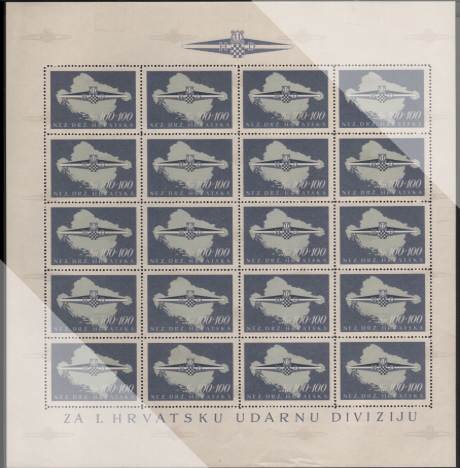
1945 NDH - Storm Division Sheets

The 1st Croatian Storm Division (Udarna divizija) was an elite unit formed on October 9, 1944. To commemorate the unit, a special philatelic issue was released on January 9, 1945. Today, complete sheets of this issue are considered among the gems of NDH philately.

Mi. 170, 50 + 50, Soldiers of the Storm Division.

Mi. 171, 70 + 70, A battlefield at night.

Mi. 172, 100 + 100, The Storm Division insignia on top of the Croatia map.

Saturday, January 17, 2026

1945 MOSTAR – Mystery Postal Card

A notable postal card sent from Široki Brijeg to Belgrade in June 1945 raises some questions. The card was broken in half at some point, but the exact circumstances of its severance and the identity of the repairer remain a mystery. While the exact moment of damage cannot be determined with absolute certainty, the presence of official "VOJNA CENZURA BEOGRAD" (Military Censorship Belgrade) tapes suggests that it is most likely that the card was severed during the censorship process. Whether it was damaged during the hurried opening of mail bags or rough handling during inspection, the fact that it was resealed with official adhesive tape points to an official intervention before it reached the addressee.

1945 Mostar Provisional Issue, Postal Card, sent from Široki Brijeg to Belgrade on June 14, 1945. Censored by Military Censor in Belgrade with a framed three-line cachet "ЦЕНЗУРИСАНО БЕОГРАД Војни цензор, бр. 10". Post offices tolerated late use of the Split Tariff for postal cards until their withdrawal from circulation. The postal card was broken in half and subsequently resealed with official censor tapes.

Monday, January 12, 2026

1945 SPLIT - Postal Card Overprint Varieties

The 1945 Split Provisional Type 1 postal card features a two-colour overprint in red and black. Because this process required two separate passes through the printing press, it resulted in the interesting varieties shown below...

1945 Split Provisional Issue, Postal Card Type 1.

Slanted black overprint.

Inverted red overprint.

Inverted black overprint.

Double black overprint.

Thursday, January 8, 2026

1945 SPLIT - Curved Perforation

One accidental flaw in line perforation is irregular or wavy perforation. This type of anomaly is a specific risk of line perforation machinery; unlike comb perforation, where the grid is fixed, line perforation processes each line independently. This flaw occurs when the sheet of paper is not perfectly aligned or shifts slightly during feeding. If the paper moves while passing under the perforating needles, the needles strike in a curved or wavy path rather than a straight line, resulting in a structural dislocation.

1945 Split Provisional Issue, block of four showing a distinctive misplaced and curved perforation on the left margin. The upper part of the vertical perforation deviates by 2.3 mm from the true vertical line, resulting in a pronounced irregular curvature. An attractive and rarely seen perforation error.

Tuesday, January 6, 2026

1941 LJUBLJANA - Mail to Novi Sad

During the war, mail followed complex routes, as all items were redirected to central censorship offices before being forwarded to their destination. Correspondence from Ljubljana was sent deep into Italy to centres like Bologna for examination before being returned to the postal system for final delivery. As shown on the cover below, in occupied Vojvodina, the postal service was evidently managed by the Hungarian military post at that time.

Registered cover franked with 9.00 Din, sent from Ljubljana on May 31, 1941, to Novi Sad. "Hongrie" was added in manuscript as Novi Sad was under Hungarian occupation. The letter was censored by UFFICIO CENSURA POSTA ESTERA II in Bologna (censor mark 245/II) and handled by the Hungarian military post M.KIR.POSTA 335 on June 11, 1941.

Saturday, January 3, 2026

1944 DB Laibach, Chemical Censorship

During World War II, German military censorship was applied to all mail in occupied territories. Censors scrutinised entire messages and redacted prohibited content. To bypass these measures, individuals sometimes used invisible ink—also known as sympathetic or covert ink. However, this was a risky endeavour, as the Auslandsbriefprüfstellen (ABP) subjected approximately 3% of all mail to chemical testing to detect hidden messages.

Registered cover, franked with 2.50 Lit., sent from Laibach (Ljubljana) on August 28, 1944, to Franz, Steiermark (Vransko, Styria), arriving September 20, 1944. Processed by the Foreign Mail Examination Office in Vienna. The front features several censorship markings, including a dark blue 'Y' (laboratory) and red 'W' (supervisor review), along with a green examiner's stamp '8635'. The reverse shows a chemical censorship swipe (test for invisible ink). The cover was resealed with censorship tape, marked with a red machine-applied censor mark.

Vienna censor codes:
1000 - 3000 Regular Mail
4000 - 6000 Registered and Express mail
8000+ Specialised departments (Chemical/Language specialists)